


A Research Achievement from the Artificial Intelligence Drug Discovery Center at Macao Polytechnic University has been published in the prestigious international journal Nature Communications
A Research Achievement from the Artificial Intelligence Drug Discovery Center at Macao Polytechnic University has been published in the prestigious international journal Nature Communications
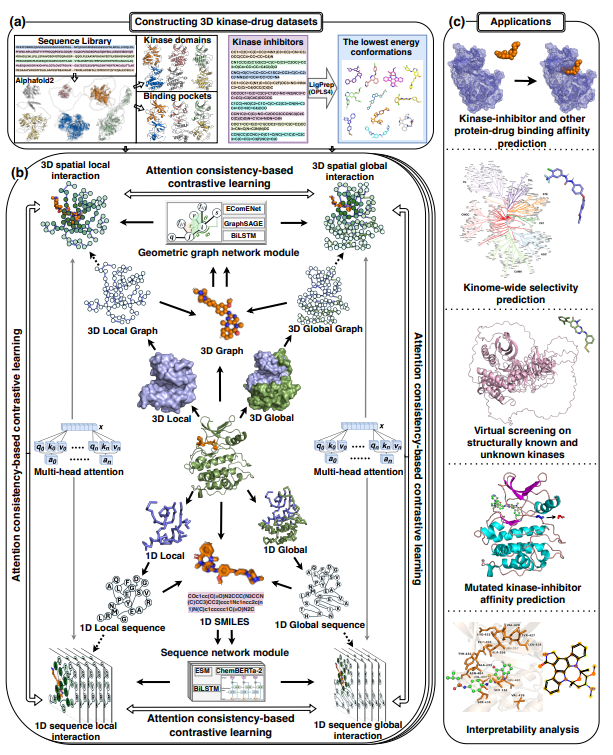
A research progress led by Professor Liu Huanxiang, Professor Yao Xiaojun and Professor Henry Tong from the Artificial Intelligence Drug Discovery Center of Macao Polytechnic University has been published in the prestigious international journal Nature Communications. The first author is Tian Yanan, a Ph.D. candidate at Macao Polytechnic University. The research introduces an innovative multimodal and multiscale contrastive learning framework based on attention consistency, named MMCLKin, which can effectively capture the complex relationships between kinases and drugs. This work provides a novel technological pathway for the discovery of high-affinity and high-selectivity kinase inhibitors.
Protein kinases, as central regulatory molecules in cellular signal transduction, are one of the most important drug targets of the 21st century. However, the high evolutionary conservation of kinase structures, together with the substantial cost of kinome-wide profiling, renders the development of highly selective kinase inhibitors particularly challenging. Establishing high-precision methods for evaluating the activity and selectivity of kinase inhibitors is therefore crucial. To address these challenges, the research team proposed an attention consistency-guided contrastive learning framework, MMCLKin. This approach integrates geometric graph neural networks with sequence-based networks, and leverages multi-head attention mechanisms and multimodal, multiscale contrastive learning to achieve accurate prediction of kinase–inhibitor activity and selectivity. MMCLKin outperformed existing methods on two three-dimensional kinase–drug datasets and demonstrated strong generalization capabilities across ten protein–ligand datasets and one mutation-aware dataset. It also proved effective in screening both structurally known and unknown kinases. Attention analysis further revealed that MMCLKin can identify key residues and molecular functional groups related to kinase–inhibitor binding. Furthermore, ADP-Glo assays validated that 5 out of 20 compounds prioritized by MMCLKin exhibited inhibitory activity against the pathogenic LRRK2 G2019S mutant, with four demonstrating nanomolar-level potency.
The related research findings have been published in the prestigious international journal Nature Communications under the title "Enhancing kinase-inhibitor activity and selectivity prediction through contrastive learning". This study was supported by grants from the Macao Science and Technology Development Fund (0043/2023/AFJ) and the Macao Polytechnic University (No. RP/FCA-02/2023). The full text can be accessed at https://www.nature.com/articles/s41467-025-65869-8 (doi: https://doi.org/10.1038/s41467-025-65869-8).
Nature Communications, published by the Nature Portfolio in the United Kingdom, is dedicated to highlighting significant breakthroughs across life sciences, health, physical sciences, chemistry, earth sciences, as well as social sciences. The journal has an impact factor of 15.7 in 2024 and a 5-year impact factor of 17.2. Nature Communications ranks in Q1 across multiple subject categories, including multidisciplinary sciences, biochemistry, genetics, physics, and astronomy. It is positioned within the top 5% of journals in the multidisciplinary sciences field and is recognized as a China Academy of Sciences (CAS) Tier 1 TOP journal.
A Research Team from Macao Polytechnic University Develops Innovative Method for Predicting Kinase-Drug Affinity and Selectivity
A research achievement by the Artificial Intelligence Drug Design Center at Macao Polytechnic University has been published in the prestigious international journal, Nature Communications